
 Tweet
Tweet
I've been working on this post for a little while, and the new forum is a good opportunity to post it.
Several forum members have infrared- and full spectrum-converted m4/3 bodies, but there are few resources focused on m4/3 across the web, and some of the information I have found is not correct, at least by my own experience. It seems a good idea to provide an opportunity to pull together the resources we have plus our collective experience.
I know that the resulting images can be marmite – I love many of them, but others can’t see the point, and that’s fine by me
I’m no expert on the technical and practical aspects of sensor conversions or on the filter choices one has to make. Similarly, almost all the information on processing colour or mono images relates to Photoshop and Lightroom, neither of which I use, and so I’m not going to post much at all on PP.
To save me having to cover them, here are some useful basic and advanced resources from the established and widely-recommended UK and US companies selling IR conversions:


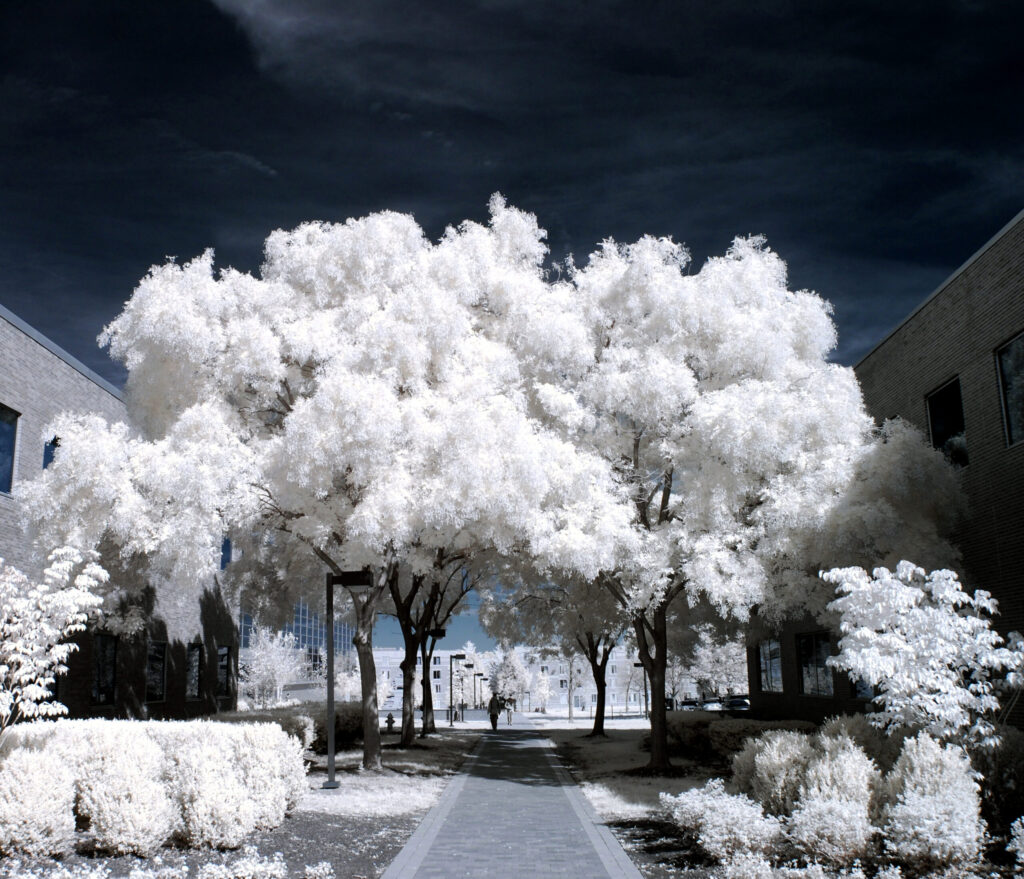
However, I have now got quite a bit of experience with converting mono 720nm filtered raw images and some colour ones with Capture One Pro, and I get results that satisfy me at least! Maybe I’m just easily pleased, but I’ve discussed this with CO experts, and I’m sure this relates to the particular way CO colour management is implemented. It just seems to suit IR processing, and you don’t need to get involved with ‘channel swapping’ and other witchcraft. After raw conversion, in my experience the Nik suite is brilliant for enhancing detail and tonal contrasts.
After a brief introduction, I’m going to describe in the rest of this first post which m4/3 lenses I have personally tested for IR use (principally with 720nm filters).
I hope to add a few more posts, including why I chose the gear I did and why I had it converted to full spectrum by Protech ( https://www.protechrepairs.co.uk/inf...r_choices.html ).
Modern lenses are super-optimised for handling the wavelengths of the visible spectrum, and as soon as your sensor starts detecting longer wavelengths all sorts of strange things happen. Sophisticated lens coatings may flare badly in IR, nasty colour casts and internal reflections are frequent, and since IR wavelengths may be brought to a different focus from the visible range, soft focus may be inherent especially as you widen the spectrum detected. It’s often said that older lenses with more basic coatings and simpler optical formulae are more reliably usable for IR.
The commonest problem with many lenses is a central ‘hot spot’ of brighter imaging, often covering the central 30% or so of the frame. Although I’ve never seen this written down, this seems mainly to be a central colour hot spot, and the ones caused by many lenses seem largely to disappear when you do the raw conversion. They are also often amenable to fiddling around with blue sensitivity in the raw converter, and if all else fails, skilled use of radial masking will fix the issue.
There’s no doubt, however, that avoiding hot spots from the beginning by careful choice of lens is the simplest and quickest solution. Different optics vary enormously in the quality of their images through a 720nm filter, and it’s not predictable. For example, the 40-150 f2.8 Pro zoom is excellent, certainly from f2.8 to 5.6; in contrast, the 12-100 f4 Pro is appalling at all apertures (brown cast, soft, awful hot-spot).
Hot spots are often only an issue when partially stopped down, and some modern lenses with sophisticated optics are actually very good in my experience at full aperture – the Olympus f1.2 17mm and 45mm Pro primes being cases in point. Stop them down to beyond around f4, however, and they’re hopeless.
Especially in bright sunlight (when IR light is plentiful, and IR photography comes in to its own) I find my optics quite sensitive to flare, so I always use a lens hood and often give additional shading with my hand. This might be more of an issue for me since I must add a filter to the front of the lens with my full spectrum camera.
So, here are my results for the m4/3 lenses I’ve tried on my E-M10ii with a full spectrum conversion by Protech and screw-on 720nm filters (a mix of Hoya, B+W and Zomei of different diameters). This is not a scientific study, and is based only on fairly quick and dirty eyeballing of raw files imported to CO.
If a range of apertures isn’t given for which a lens is described as ‘Good’ I tested it from full aperture as far as f8.0. I tested zooms fully wide, fully tele, and around halfway between – in fact I didn’t spot any significant differences in IR performance for any of them throughout the focal length range with the quick and subjective assessment I used.
Others’ mileage may well differ with different equipment, and my experience with some lenses certainly differs from some recommendations to be found on the web, maybe for this reason. In this list, ‘Poor’ optics & settings often give usable images after tweaking in post, ‘Awful’ is just that.
Olympus
9-18 f4.0-5.6 Good.
12-100 Awful (brown cast, soft, hot-spot).
17 f1.2 Good f1.2 to f2.8, awful hot-spot after f4.0.
40-150 f2.8 Good f2.8 to 5.6, worsening hot-spot after that.
45 f1.2 Good f1.2 to f2.8, awful hot-spot after f4.0.
75mm f1.8 Good to f2.8, acceptable to f5.6, worsening hot-spot after that.
Panasonic
12-32 f3.5-5.6 Good.
12-35 f2.8 Good to f4.0, acceptable to f5.6, increasing hot spot after that.
15 f1.7 Good.
35-100 f4.0-5.6 Good.
Laowa
7.5 f2.0 Awful (soft, brown cast).
Samyang
7.5mm f3.5 fisheye Good (I sold this lens before testing it properly, but I tended to leave it at f5.6 permanently, and it was fine at that).
I have a few more lenses I haven’t yet tried for IR, e.g. the Olympus 8mm f1.8 fisheye, and I’ll update this thread when I have.
You don’t often just want to carry an IR-converted body (although I do have a high-quality 37mm B+W IR and UV blocking filter, which fits the Panny 12-32 and gives a decent approximation of normal visible light). Hence, I’d say that converting a small body is sensible: several of my camera club members have converted various iterations of the Sony RX100, but adding external filters to that is a pain and I did want a full-spectrum conversion, and the light and compact M10ii fits my needs well.Many people convert a body they've just upgraded, rather than selling it. I bought the M10ii new, but it was on a short-lived and crazy SRS deal for around £230 after various discounts and cashback, which was hard to resist.
My standard IR setup is just to add the M10ii with the Panny 12-32 to whatever else I’m carrying, but when I know I’m going to have particularly good opportunities for IR work (midday sunshine, lots of trees & plants) I also bring along the 9-18 and 35-100.


Several forum members have infrared- and full spectrum-converted m4/3 bodies, but there are few resources focused on m4/3 across the web, and some of the information I have found is not correct, at least by my own experience. It seems a good idea to provide an opportunity to pull together the resources we have plus our collective experience.
I know that the resulting images can be marmite – I love many of them, but others can’t see the point, and that’s fine by me
I’m no expert on the technical and practical aspects of sensor conversions or on the filter choices one has to make. Similarly, almost all the information on processing colour or mono images relates to Photoshop and Lightroom, neither of which I use, and so I’m not going to post much at all on PP.
To save me having to cover them, here are some useful basic and advanced resources from the established and widely-recommended UK and US companies selling IR conversions:
However, I have now got quite a bit of experience with converting mono 720nm filtered raw images and some colour ones with Capture One Pro, and I get results that satisfy me at least! Maybe I’m just easily pleased, but I’ve discussed this with CO experts, and I’m sure this relates to the particular way CO colour management is implemented. It just seems to suit IR processing, and you don’t need to get involved with ‘channel swapping’ and other witchcraft. After raw conversion, in my experience the Nik suite is brilliant for enhancing detail and tonal contrasts.
After a brief introduction, I’m going to describe in the rest of this first post which m4/3 lenses I have personally tested for IR use (principally with 720nm filters).
I hope to add a few more posts, including why I chose the gear I did and why I had it converted to full spectrum by Protech ( https://www.protechrepairs.co.uk/inf...r_choices.html ).
Modern lenses are super-optimised for handling the wavelengths of the visible spectrum, and as soon as your sensor starts detecting longer wavelengths all sorts of strange things happen. Sophisticated lens coatings may flare badly in IR, nasty colour casts and internal reflections are frequent, and since IR wavelengths may be brought to a different focus from the visible range, soft focus may be inherent especially as you widen the spectrum detected. It’s often said that older lenses with more basic coatings and simpler optical formulae are more reliably usable for IR.
The commonest problem with many lenses is a central ‘hot spot’ of brighter imaging, often covering the central 30% or so of the frame. Although I’ve never seen this written down, this seems mainly to be a central colour hot spot, and the ones caused by many lenses seem largely to disappear when you do the raw conversion. They are also often amenable to fiddling around with blue sensitivity in the raw converter, and if all else fails, skilled use of radial masking will fix the issue.
There’s no doubt, however, that avoiding hot spots from the beginning by careful choice of lens is the simplest and quickest solution. Different optics vary enormously in the quality of their images through a 720nm filter, and it’s not predictable. For example, the 40-150 f2.8 Pro zoom is excellent, certainly from f2.8 to 5.6; in contrast, the 12-100 f4 Pro is appalling at all apertures (brown cast, soft, awful hot-spot).
Hot spots are often only an issue when partially stopped down, and some modern lenses with sophisticated optics are actually very good in my experience at full aperture – the Olympus f1.2 17mm and 45mm Pro primes being cases in point. Stop them down to beyond around f4, however, and they’re hopeless.
Especially in bright sunlight (when IR light is plentiful, and IR photography comes in to its own) I find my optics quite sensitive to flare, so I always use a lens hood and often give additional shading with my hand. This might be more of an issue for me since I must add a filter to the front of the lens with my full spectrum camera.
So, here are my results for the m4/3 lenses I’ve tried on my E-M10ii with a full spectrum conversion by Protech and screw-on 720nm filters (a mix of Hoya, B+W and Zomei of different diameters). This is not a scientific study, and is based only on fairly quick and dirty eyeballing of raw files imported to CO.
If a range of apertures isn’t given for which a lens is described as ‘Good’ I tested it from full aperture as far as f8.0. I tested zooms fully wide, fully tele, and around halfway between – in fact I didn’t spot any significant differences in IR performance for any of them throughout the focal length range with the quick and subjective assessment I used.
Others’ mileage may well differ with different equipment, and my experience with some lenses certainly differs from some recommendations to be found on the web, maybe for this reason. In this list, ‘Poor’ optics & settings often give usable images after tweaking in post, ‘Awful’ is just that.
Olympus
9-18 f4.0-5.6 Good.
12-100 Awful (brown cast, soft, hot-spot).
17 f1.2 Good f1.2 to f2.8, awful hot-spot after f4.0.
40-150 f2.8 Good f2.8 to 5.6, worsening hot-spot after that.
45 f1.2 Good f1.2 to f2.8, awful hot-spot after f4.0.
75mm f1.8 Good to f2.8, acceptable to f5.6, worsening hot-spot after that.
Panasonic
12-32 f3.5-5.6 Good.
12-35 f2.8 Good to f4.0, acceptable to f5.6, increasing hot spot after that.
15 f1.7 Good.
35-100 f4.0-5.6 Good.
Laowa
7.5 f2.0 Awful (soft, brown cast).
Samyang
7.5mm f3.5 fisheye Good (I sold this lens before testing it properly, but I tended to leave it at f5.6 permanently, and it was fine at that).
I have a few more lenses I haven’t yet tried for IR, e.g. the Olympus 8mm f1.8 fisheye, and I’ll update this thread when I have.
You don’t often just want to carry an IR-converted body (although I do have a high-quality 37mm B+W IR and UV blocking filter, which fits the Panny 12-32 and gives a decent approximation of normal visible light). Hence, I’d say that converting a small body is sensible: several of my camera club members have converted various iterations of the Sony RX100, but adding external filters to that is a pain and I did want a full-spectrum conversion, and the light and compact M10ii fits my needs well.Many people convert a body they've just upgraded, rather than selling it. I bought the M10ii new, but it was on a short-lived and crazy SRS deal for around £230 after various discounts and cashback, which was hard to resist.
My standard IR setup is just to add the M10ii with the Panny 12-32 to whatever else I’m carrying, but when I know I’m going to have particularly good opportunities for IR work (midday sunshine, lots of trees & plants) I also bring along the 9-18 and 35-100.
Attached Files


 ).
).


Comment